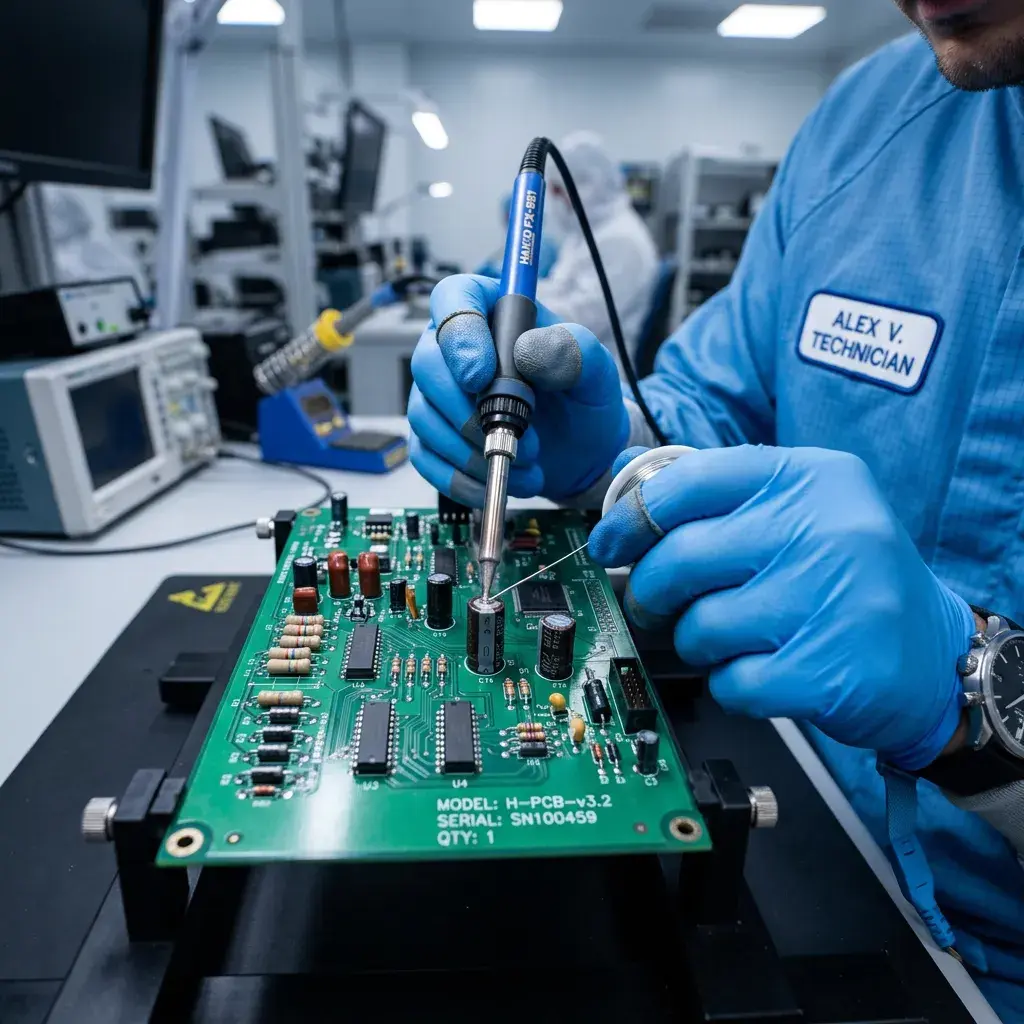
What is Through Hole Technology (THT)?
Through Hole Technology (THT) — also called Through Hole Assembly — is a method of mounting electronic components by inserting their leads through pre-drilled holes in a printed circuit board and soldering them on the opposite side. While Surface Mount Technology (SMT) has largely replaced THT for high-density applications, through hole assembly remains indispensable for components requiring superior mechanical bond strength.
The THT Assembly Process
Through hole assembly follows a systematic process optimized for reliability:
1. Component Preparation & Insertion
Components are prepared with proper lead forming and inserted into the PCB holes — either manually by skilled technicians or via automated insertion machines. At TOS Lanka, our technicians are Japan-trained in precision hand insertion techniques for complex components.
2. Wave Soldering
Wave soldering is the primary method for simultaneously soldering all through-hole joints on a PCB. The board passes over a molten solder wave that contacts the exposed leads and pad areas on the bottom side. Modern wave soldering machines feature dual-wave systems — a turbulent "chip wave" for close-pitch components followed by a smooth "laminar wave" for clean, reliable joints.
Wave soldering is ideal for high-volume production where consistent, repeatable results are required. It pairs naturally with reflow soldering in mixed-technology boards that combine SMT and THT components.
3. Manual Soldering
Manual soldering (hand soldering) remains critical for:
- Heat-sensitive components that cannot withstand wave soldering temperatures
- Large connectors and transformers requiring special attention
- Prototype assemblies with small batch sizes
- Rework and repair operations
- Components in restricted areas that wave cannot reach
TOS Lanka's technicians undergo rigorous Japanese-standard training in manual soldering, ensuring IPC-A-610 Class 3 quality on every solder joint.
When to Choose THT Over SMT
Through hole assembly excels in specific scenarios:
- High-reliability applications: Aerospace, military, and medical device electronics where mechanical failure is unacceptable
- High-power components: Transformers, large capacitors, and power semiconductors that generate significant heat
- Automotive electronics: Applications subject to extreme vibration and thermal cycling
- Industrial control systems: Equipment in harsh environments requiring exceptional durability
- Connectors and headers: Components requiring strong mechanical connections for repeated mating cycles
Mixed Technology Assembly: SMT + THT
Modern electronic manufacturing frequently combines both technologies on a single board. Surface mount components are placed and reflowed first, followed by through-hole component insertion and wave soldering or selective soldering. This mixed approach leverages the high density of SMT with the mechanical strength of THT.
THT Assembly at TOS Lanka, Sri Lanka
At TOS Lanka's THT facility, we provide:
- Automated component insertion machines for standard THT parts
- Advanced wave soldering systems with nitrogen atmosphere for superior joint quality
- IPC-certified manual soldering by Japan-trained technicians
- Full in-circuit testing (ICT) and automated optical inspection
- Mixed-technology assembly combining SMT and THT processes
Whether you are manufacturing cable harnesses for automotive clients or inductive components for industrial power supplies, TOS Lanka has the expertise and equipment to deliver zero-defect through hole assemblies. Contact us for a quote.