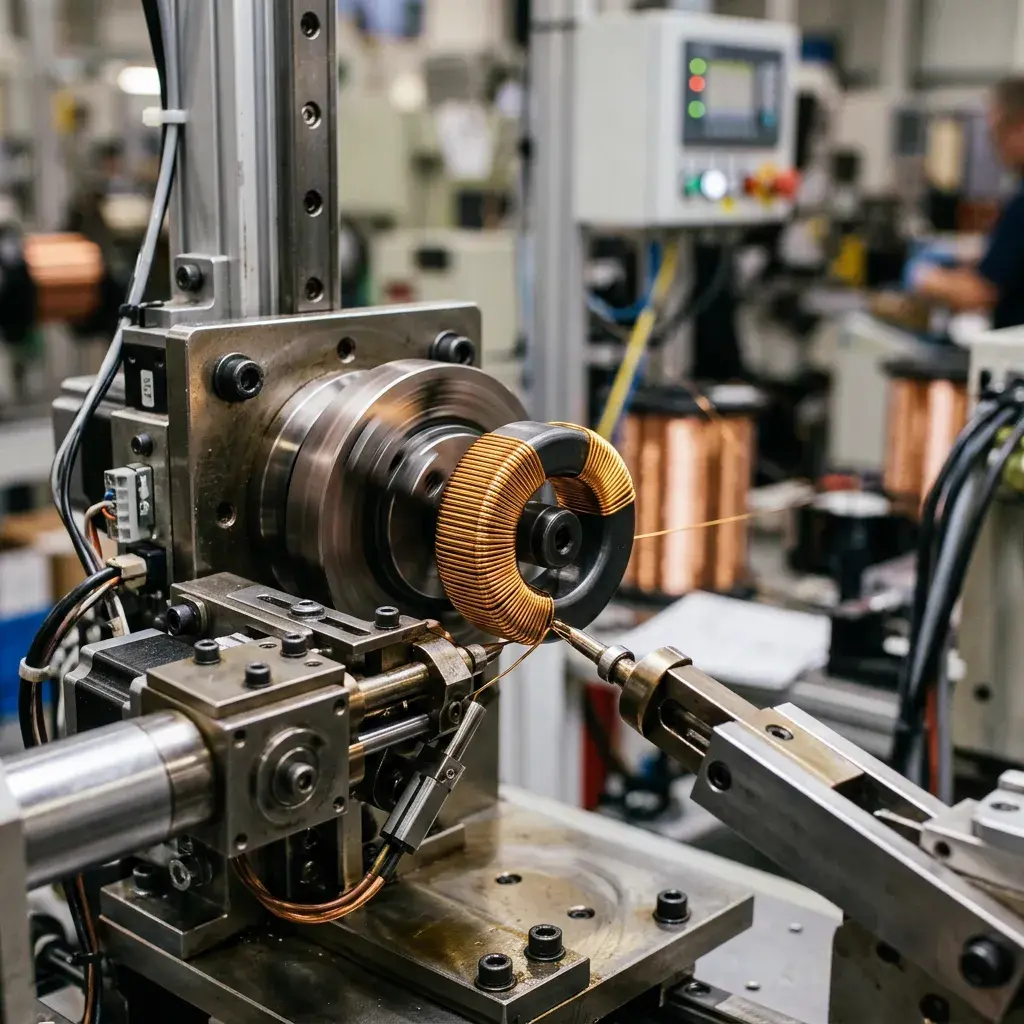
Understanding Inductive Components
Inductive components — coils, transformers, chokes, and inductors — are fundamental building blocks of electronic circuits. They store energy in magnetic fields, filter signals, transform voltages, and suppress electromagnetic interference. The quality of coil winding and assembly directly determines the performance, efficiency, and reliability of these critical components.
In industrial electronics, inductive components must withstand demanding operating conditions including high temperatures, significant vibration, and continuous duty cycles. This makes precision manufacturing and rigorous quality control essential.
Types of Inductive Components
Transformers
Transformers transfer electrical energy between circuits through electromagnetic induction. Coil winding for transformers requires precise control of turns count, wire spacing, layer insulation, and winding tension to achieve specified voltage ratios, impedance characteristics, and efficiency ratings.
Inductors
Inductors store energy in a magnetic field and are used in power supply filters, DC-DC converters, and signal processing circuits. Precision coil winding ensures consistent inductance values and quality factors (Q) across production runs.
Chokes
Common-mode and differential-mode chokes filter electromagnetic interference (EMI) in power and signal systems. Balanced winding is critical for common-mode rejection performance.
Solenoids and Actuators
Electromechanical solenoid assemblies convert electrical energy to linear or rotary motion. Winding quality directly affects force output, duty cycle capability, and service life.
The Coil Winding Process
1. Core Preparation
Magnetic cores (ferrite, iron powder, laminated steel, or air-core bobbins) are inspected for dimensional accuracy and magnetic properties before winding begins.
2. Wire Winding
Precision winding machines wind magnet wire onto cores or bobbins with controlled tension, speed, and layer placement. Variables include:
- Wire gauge selection (from ultra-fine 50 AWG to heavy 10 AWG)
- Turns count accuracy (critical for voltage ratios and inductance values)
- Winding pattern (layer wound, random wound, or progressive wound)
- Layer insulation application between winding layers
- Multiple winding sections for multi-tap transformers
3. Termination
Wire ends are terminated to pins, pads, or flying leads through soldering, crimping, or welding processes. Proper termination ensures reliable electrical connections.
4. Assembly & Encapsulation
Wound components are assembled into their final housings, potted with epoxy when required for environmental protection, and prepared for final testing.
5. Electrical Testing
Every inductive component is tested for:
- Inductance value at specified frequency and current
- DC resistance (DCR) of windings
- Turns ratio accuracy (transformers)
- High-voltage insulation resistance (hipot testing)
- Quality factor (Q) and impedance characteristics
Applications in Industrial Electronics
Coil winding and inductive components serve diverse industrial applications:
- Industrial power supplies and UPS systems — power transformers, output inductors
- Motor drives and VFDs — line reactors, EMI chokes
- Automotive electronics — ignition coils, sensor excitation transformers
- Telecommunications — signal transformers, baluns
- Medical devices — isolated power transformers, signal coupling
- Renewable energy — inverter inductors, solar MPPT coils
Coil Winding at TOS Lanka
TOS Lanka's inductive components division delivers expert coil winding and assembly services:
- Precision winding machines for consistent, repeatable quality
- Experienced technicians handling sensitive magnetic components
- Full electrical testing of every finished component
- Flexible production from prototype to high-volume
- Integration with PCB assembly and box build
For expert coil winding and industrial electronics manufacturing, contact TOS Lanka today.