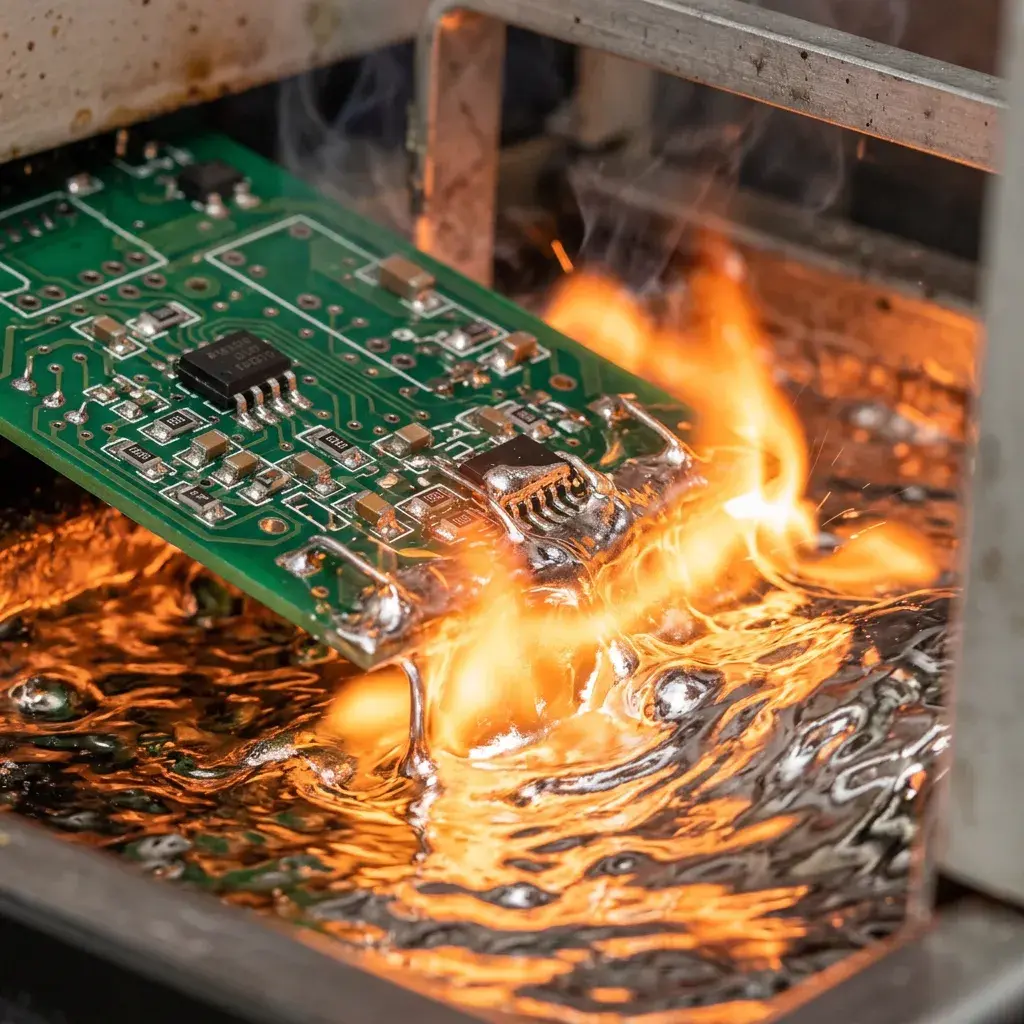
Soldering: The Foundation of Electronic Assembly
Soldering is the process that creates permanent electrical and mechanical bonds between electronic components and printed circuit boards. In modern electronic manufacturing, three primary soldering methods are used: reflow soldering, wave soldering, and manual soldering. Understanding when to apply each method is essential for achieving optimal assembly quality.
Reflow Soldering
Reflow soldering is the standard process for Surface Mount Technology (SMT) assemblies. The process works as follows:
- Solder paste (tiny solder particles mixed with flux) is applied to PCB pads through a stencil
- SMT components are placed onto the paste deposits by pick-and-place machines
- The entire board passes through a reflow oven with carefully controlled temperature zones
- The solder paste melts ("reflows"), forming metallurgical bonds, then solidifies as the board cools
Reflow Temperature Profile
A typical lead-free reflow profile consists of four zones:
- Preheat (25°C → 150°C): Gradual ramp to activate flux and minimize thermal shock
- Thermal soak (150°C → 200°C): Temperature equalization across the board
- Reflow (200°C → 245-260°C peak): Solder melts and wets component leads and pads
- Cooling (260°C → 25°C): Controlled cooling for strong crystalline solder joint structure
Advantages of Reflow Soldering
- Ideal for fine-pitch and ultra-small SMT components
- Both sides of the board can be assembled
- Excellent for high-density, high-volume production
- Precise, repeatable temperature control
- Lower thermal stress compared to wave soldering
Wave Soldering
Wave soldering is the traditional method for through hole assembly (THT). The process involves:
- Components are inserted through PCB holes (manually or by machine)
- Flux is applied to the bottom of the board
- The board passes over a wave of molten solder
- The wave contacts the leads and pads simultaneously, soldering all joints at once
Advantages of Wave Soldering
- Efficient for soldering many through hole joints simultaneously
- Well-suited for connectors, transformers, and large components
- High throughput for mixed-technology boards
- Well-established, reliable process with decades of proven performance
Manual Soldering
Manual soldering (hand soldering) uses a temperature-controlled soldering iron to make individual solder joints. While slower than automated methods, manual soldering remains essential for:
- Prototype assemblies with small batch sizes
- Heat-sensitive components that cannot withstand oven temperatures
- Rework and repair operations on defective joints
- Components in areas inaccessible to wave or selective soldering
- Specialized applications like cable harness termination
At TOS Lanka, our Japan-trained technicians deliver IPC-certified manual soldering quality for the most demanding applications.
Choosing the Right Process
| Criteria | Reflow Soldering | Wave Soldering | Manual Soldering |
|---|---|---|---|
| Component type | SMT | THT | Both |
| Volume | Medium to high | Medium to high | Low / rework |
| Joint quality | Excellent | Very good | Operator dependent |
| Speed | High | High | Low |
| Mixed-tech boards | SMT side | THT side | Supplemental |
Soldering Capabilities at TOS Lanka
TOS Lanka operates all three soldering methods in our integrated facility:
- Reflow soldering: Multiple SMT lines with lead-free convection reflow ovens
- Wave soldering: Advanced wave machines with nitrogen atmosphere for superior THT joints
- Manual soldering: IPC-certified, Japan-trained technicians for precision hand work
Whatever your soldering requirements, contact TOS Lanka for expert guidance and competitive manufacturing quotes.