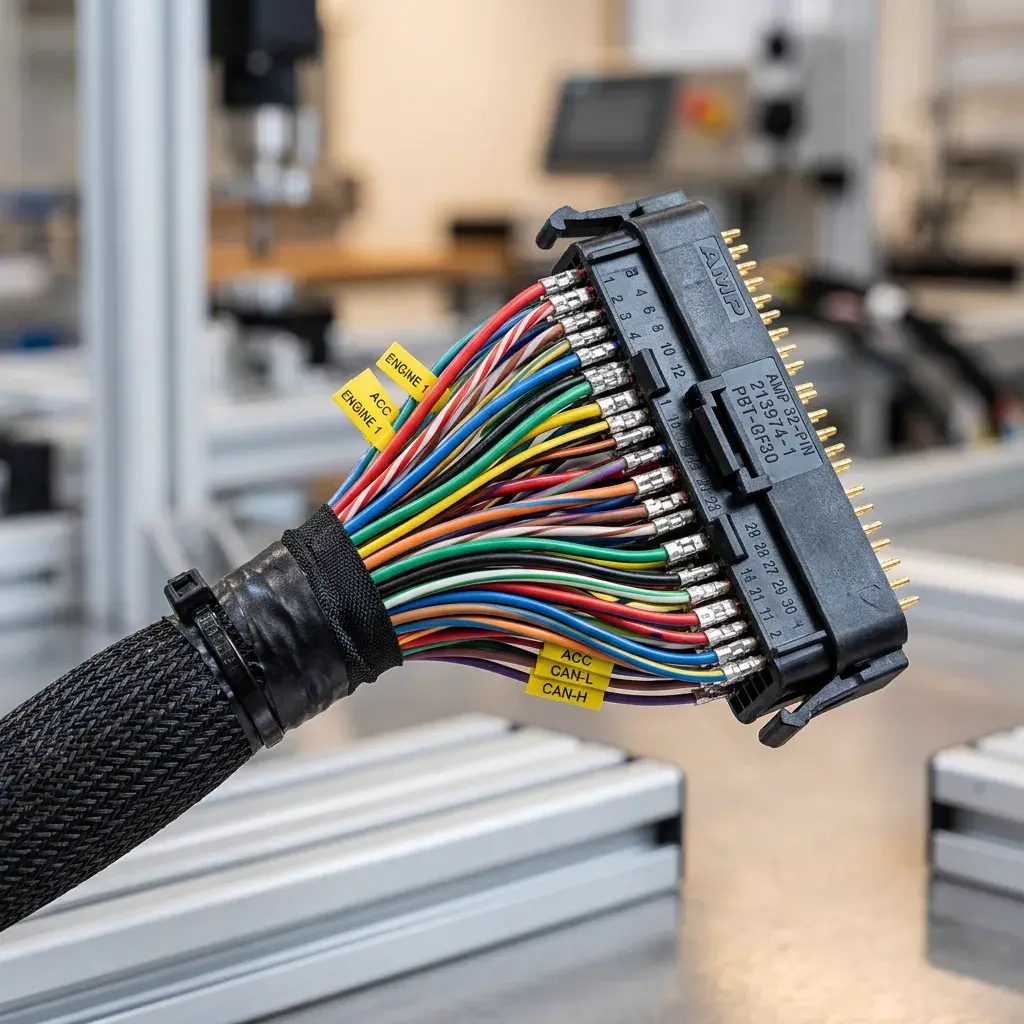
What is Cable Harness Assembly?
A cable harness (also called a wire harness or wiring loom) is an organized set of wires, cables, and connectors that transmit electrical signals and power within an electronic system. Cable harness assembly involves the process of cutting, stripping, crimping, and bundling wires into an integrated assembly that can be installed as a single unit.
In automotive electronics, cable harnesses are the nervous system of every vehicle — connecting sensors, actuators, control units, and displays across the entire platform. A modern automobile contains over 3,000 meters of wire organized into dozens of individual harness assemblies.
The Cable Harness Assembly Process
1. Design & Engineering
Cable harness design begins with electrical schematics and routing diagrams. Engineers determine wire gauges, connector types, terminal specifications, and shielding requirements based on the application's voltage, current, and environmental demands.
2. Wire Preparation
Automated cutting and stripping machines prepare wires to exact lengths with precision-stripped ends. For automotive electronics applications, wire specifications must comply with automotive standards (FLRY, GXL, SXL) for temperature resistance and flexibility.
3. Terminal Crimping
Crimping machines attach terminals to stripped wire ends with controlled force profiles. Each crimp is verified for pull strength and cross-section quality to ensure reliable electrical connections under vibration and thermal cycling.
4. Assembly & Routing
Wires are routed on assembly boards (harness boards) following the exact routing diagram. Technicians apply protective sleeves, loom wraps, grommets, and cable ties according to the design specification. At TOS Lanka, our skilled workforce handles complex harness assemblies for global automotive brands.
5. Testing & Quality Inspection
Every completed harness undergoes electrical continuity testing, insulation resistance testing, and visual inspection. For safety-critical automotive electronics — such as airbag sensor harnesses and ABS wiring — 100% testing is mandatory with full traceability documentation.
Applications of Cable Harness Assembly
- Automotive safety systems: Airbag sensor harnesses, seat belt pretensioner wiring, ABS system cables
- Engine and powertrain: Fuel injection harnesses, transmission control wiring, EV battery cables
- Industrial control systems: Factory automation wiring, PLC cable assemblies, sensor harnesses
- Medical devices: Patient monitoring cable assemblies, imaging equipment harnesses
- Telecommunications: Data center cabling, network equipment harnesses
Quality Standards for Cable Harness Manufacturing
At TOS Lanka, every cable harness assembly meets stringent quality requirements:
- IPC/WHMA-A-620 workmanship standards for cable and wire harness assemblies
- ISO 9001:2015 certified quality management system
- Automotive-grade 100% end-of-line electrical testing
- Full material traceability from raw wire to finished harness
- Environmental testing for temperature, vibration, and humidity resistance
Cable Harness Assembly at TOS Lanka
TOS Lanka's automotive harnessing division has extensive experience assembling cable harnesses for major global brands. Our capabilities include:
- Safety sensor harnesses for seat belt and airbag systems
- ABS and braking system wiring assemblies
- EV cable harnesses for electric vehicles
- Custom industrial and medical device cable assemblies
Combined with our SMT and THT capabilities, we offer complete EMS solutions from PCB assembly through box build and cable harness integration. Request a quote today.